
Home
The Buzz on ‘Be a Beekeeper for a Day’
by Karen Plourde, Editor, Weavers Way Shuttle
May 12, 2026
If you’re a fan of bees (and who isn’t nowadays?) and you want to take your fandom to the next level, you may want to enroll in Mark Berman’s three-hour dive into bees and beekeeping, “Be a Beekeeper for a Day,” which he offers at the home of his beehives, Growing Together Community Garden in South Philly.
Berman, 56, is the owner and purveyor of Anna Bees Honey, which he runs out of his home in South Philly. He’s a 2024 graduate of Cornell University’s Master Beekeeper program. By day, he’s the creative director at a nonprofit.
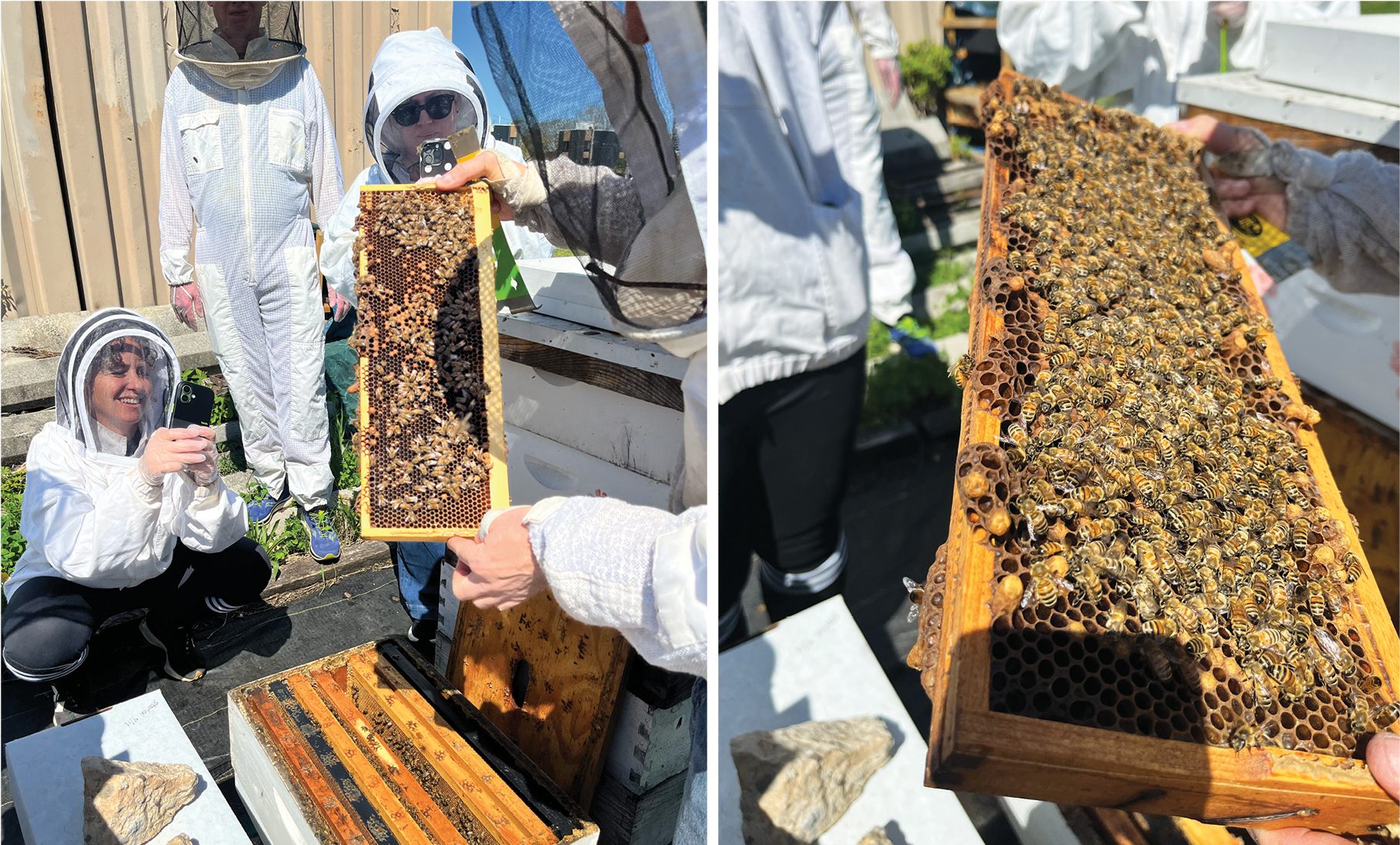
The Saturday class I participated in took place on a clear, mild morning last month. There were 10 of us in the group: A couple members were interested in possibly taking up beekeeping, but most were there to learn more about bees.
Berman started the class with a laid-back seminar on all things bees. He explained the difference between hives and colonies, the percentage of workers to drones in a colony, the nuts and bolts of mating and other fun facts. Here are a few:
- The queen in a colony (there’s almost always just one) can lay 1,500 to 2,000 eggs per day.
- If a queen lays an egg fertilized by a drone sperm, that egg becomes a female worker bee or a queen. If she lays an unfertilized egg, it becomes a male drone.
- Workers build all the cells in the frames of a hive. The cells are made of wax that comes from the underside of a 12 or 13-day-old worker bee, and store pollen, nectar and eggs. Workers produce eight flakes of wax every 12 hours.
“When the queen is laying her eggs, she measures the cell with her head and her forelegs,” Berman explained. “If it’s 5.2 millimeters wide, she’s gonna lay a fertilized egg so [it’ll] become a worker. If it’s 6.4 millimeters wide, she’s gonna lay an unfertilized egg in there. The cell’s a little bit bigger to accommodate the drone’s big butt.”
This is the time of year when the most drones are produced, he continued. As winter approaches, any remaining drones are killed and dragged out of the hive, so they don’t eat valuable resources.
Finding the Queen’s Successor
When the queen dies, or when the colony needs to swarm due to the lack of room in a hive, the worker bees try to find several worker larvae that are 12 to 36 hours old. Once they locate them, they’ll start exclusively feeding them royal jelly — a nutrient-rich, gelatinous substance secreted by workers — in the hope it will become a queen. If they want the larva to become a worker bee, they feed it worker jelly, which contains less sugar and more water than royal jelly. The worker larva is also fed far less often.
During swarm season, which happens in early spring, new queens are being raised. While the queen lays eggs in the hive, the older worker bees (known as foragers) bring in nectar — so much that after a while, the queen runs out of space to lay eggs.
Once that happens, the queen will take half of the current colony, which is made up of older foragers, and the group will meet up around 25 to 50 feet away from the old hive. They leave behind several capped swarm cells for the remainder of the colony.
“I know that they’re gonna swarm soon when those queen cells have been capped,” Berman said. “…And I can take those open cells and I can move them.”
When swarms occur, it’s helpful to have a beekeeper available who can gather the bees into a box so they can form a new colony. A couple days earlier, Berman got a call about a swarm that was in a tree within a mile of the garden, but he wasn’t able to respond.
Meeting Berman’s Bees
Armed with all this background info, we suited up for an up-close look at Berman’s hives. He supplied us with beekeeping suits, including gloves and headgear, and helped us get into them as needed.
Beekeeping suits are loaded with zippers, velcro and fabric flaps over the zippers to minimize the chance that bees will get inside your suit and sting you. At one point, a bee parked itself on my veil but flew off after a few minutes, with no damage done.
While observing the bees near and at the entrance to the hives and on the frames, I got the sense that they all knew their jobs and did them with no letup. In the spring and summer, worker and drone bees live for several weeks, so they have a lot to do in a short amount of time. Queens, meanwhile, can live for several years. Their To Do list is shorter, but equally vital.
According to Berman, there are benefits to being a honey bee in Philadelphia.
“We generally don’t have fields of pesticides and monoculture,” he said. “We have the largest park system in the country. We have 40,000 vacant lots that pretty much get ignored or mowed, but they’re not gonna be sprayed, and so there are wildflowers.”
Berman latched onto beekeeping after attending a Philadelphia Beekeeper’s Guild HoneyFest when his daughter was seven. He said in an email that he most enjoys connecting with people about honey bees and sharing his knowledge about them. “The honey is a close second,” he added.
Anna Bees Honey is available on Berman’s website, annabeeshoney.com, in addition to pollen, lip balm and candles. You can also register there for an upcoming Beekeeper for a Day class. The cost is $50 for children ages 10 and up and $75 for adults.