
Home
FOW Staffers Recommend Favorite “Trails Less Taken”
by the Friends of the Wissahickon Staff
August 6, 2026
by the Friends of the Wissahickon Staff
In the heat of summer, Wissahickon Valley Park is a retreat from the baking sun, with the cover of a lush tree canopy and the park’s winding waterways. The park welcomes more than 2.6 million visitors each year, with visitation peaking in the summer.
This influx of nature seekers may disrupt your routine or make popular access points like Bells Mill Road or the Valley Green area less accessible. Luckily, there is no shortage of access points throughout the park’s surrounding neighborhoods of Germantown, East Falls, Wissahickon, Manayunk, Roxborough, Chestnut Hill and Mt. Airy. With help from a few Friends of the Wissahickon staff members, we’ll explore a few lesser-known trailheads.
Marisa Miller, program assistant: While there are 60-plus access points to Wissahickon Valley Park, the one I use 95% of the time is the Wigard Avenue Trailhead, just past where Wigard intersects with Henry Avenue. Yeah, it’s a five-minute walk from my house, but that’s just a bonus. It also provides access to recreational space, horse-watching and the most secluded, on-trail spot for hammocking I’ve yet found in the park.
When you turn off Henry Avenue onto the driveway that leads up to the trailhead, the first thing you’ll probably notice is the pen on your right, where a dozen horses from Saul Agricultural High School graze. Next is an abundance of parking — frequent park users know how rare and wonderful that can be. You can also access this trailhead via the Route 27 bus.
I’m always surprised by how few people I see utilizing the space. Next to the kiosk, you’ll find an almost-always empty field that’s perfect for frisbee, picnicking, wildlife watching or whatever else your heart desires. I combined all the above for my birthday party last year!
As you start onto the trail, you’ll come upon another pen on the left; this one keeps deer away from the native plants protected inside — a years-long project managed by Philadelphia Parks & Recreation. It must be working, because I am always awestruck by the number of birdsongs I hear in this area. Wood thrushes, veeries and woodpeckers of all kinds gather here in droves. Don’t sleep on the Wigard Avenue trailhead — especially you RoxYunkers!
Pauline Berkowitz, director of capital projects: I’m partial to the Sumac Street Trailhead, my local trailhead in the Wissahickon neighborhood. Located at the intersection of Sumac and Vicaris streets, it exemplifies the experience of feeling transported from a city or residential street to the forest. You can access this trailhead via the Manayunk/Norristown regional rail or the Route 9 bus.
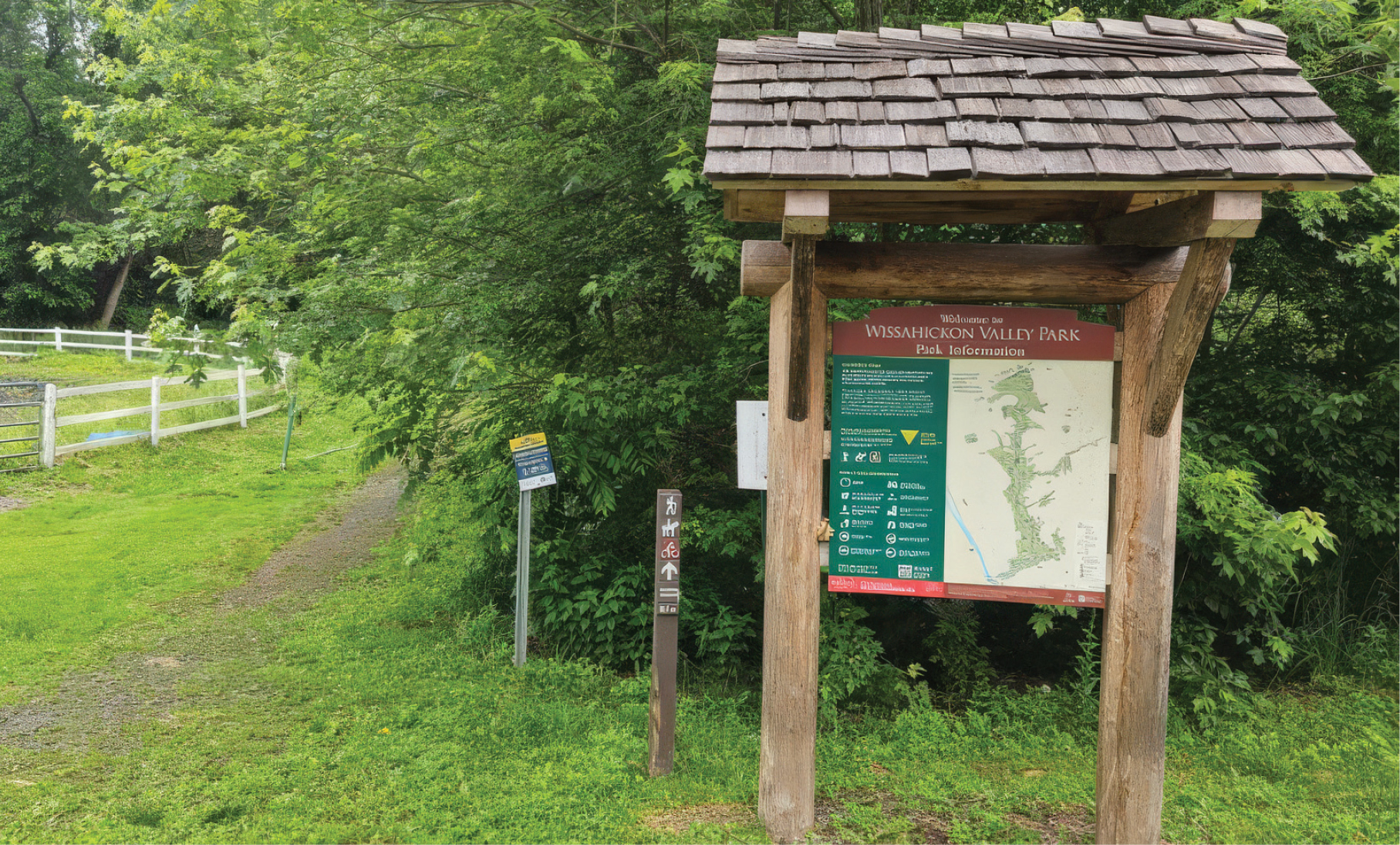
After stepping down a handful of log steps (built by FOW staff and volunteers in 2016), you come upon one of our park information kiosks, which is one of only four that includes a corkboard on the back for community notices. Go to the right and you’ll eventually reach 100 Steps (which is 103 steps long!), an iconic park attraction that connects the Wissahickon neighborhood to the Paved Wissahickon Trail.
If you take a left from the trailhead, you come upon a series of spectacular tulip poplar trees as you head toward an access trail to David P. Montgomery Field. As I walk along, I listen to the competing hums of tree rustles and cars whizzing by on Lincoln Drive until I pass Hermit’s Cave, followed by the Hermitage. From late 17th-century mystics to 19th-century mansions, both park landmarks carry much lore and merit their own articles. They are both worth visiting.
I love my trailhead so much because my route to Forbidden Drive is along a trail that carries you down into the valley, with dramatic views of Wissahickon Creek and the Blue Stone Bridge. This trail is hiker-only due to the bedrock outcrops that make up much of the trail tread. It also features a lookout where Ten Box is visible across the creek in the wintertime and is not to be missed.
Sara Stevenson, executive director: Our family turns into the Park Line Trailhead, accessed by the Route 53 bus and the Chestnut Hill West regional rail line, almost on autopilot.
Located just off Park Line Drive and Hortter Street, it’s a quiet, unassuming entrance, an unmarked gap in the trees that gives no hint of what’s beyond it. From the threshold, choices begin: hard right up the White Trail, maybe a stop at the Toleration Statue. More often, we head straight down the access trail onto the Orange Trail, past the sewer pipe and between the guardian rocks left behind by an old dynamite blast.
The route is so familiar we hardly discuss it anymore. We scramble down to Kitchen’s Lane Bridge and cut over to Dog Beach to skip stones. Back on the Orange Trail, we cross Fingerspan Bridge — unless the dog is with us. Our German shepherd mix refuses to walk on the open grating, which means I carry 60 pounds of reluctant dog across, much to my kids’ delight. Or we’ll meander along Forbidden Drive for a longer trek before looping back to Park Line.
The trailhead is my favorite because it drops us straight into the park, like jumping into the middle of a favorite novel. We pick up where we left off and already know the characters.
Still, even after countless visits, the route feels slightly different every time. A storm changes the creek crossing. A fallen tree becomes a new obstacle. The kids notice something I would have walked past. That’s the quiet magic of Park Line: familiar enough to feel like home, but never the same walk twice.
For more information about the park and how to get there, visit our website, fow.org.
We hope to see you out on the trail!