Home
A Hill Renovation Deep Dive at the Spring GMM
by Karen Plourde, Editor, Weavers Way Shuttle
June 11, 2026
For the first time since before the COVID-19 pandemic, Weavers Way members gathered in Chestnut Hill on May 7 for a General Membership Meeting. The event included a snapshot of the Co-op’s financial picture, a detailed overview of the upcoming renovations to the Chestnut Hill store, an enthusiastic talk from State Rep. Tarik Khan and the announcement of this year’s board election results.
The business portion of the meeting, which took place at St. Paul’s Church, began with General Manager Jon Roesser announcing that the Co-op is “in excellent shape,” although there are indications of “economic chop” on the horizon.
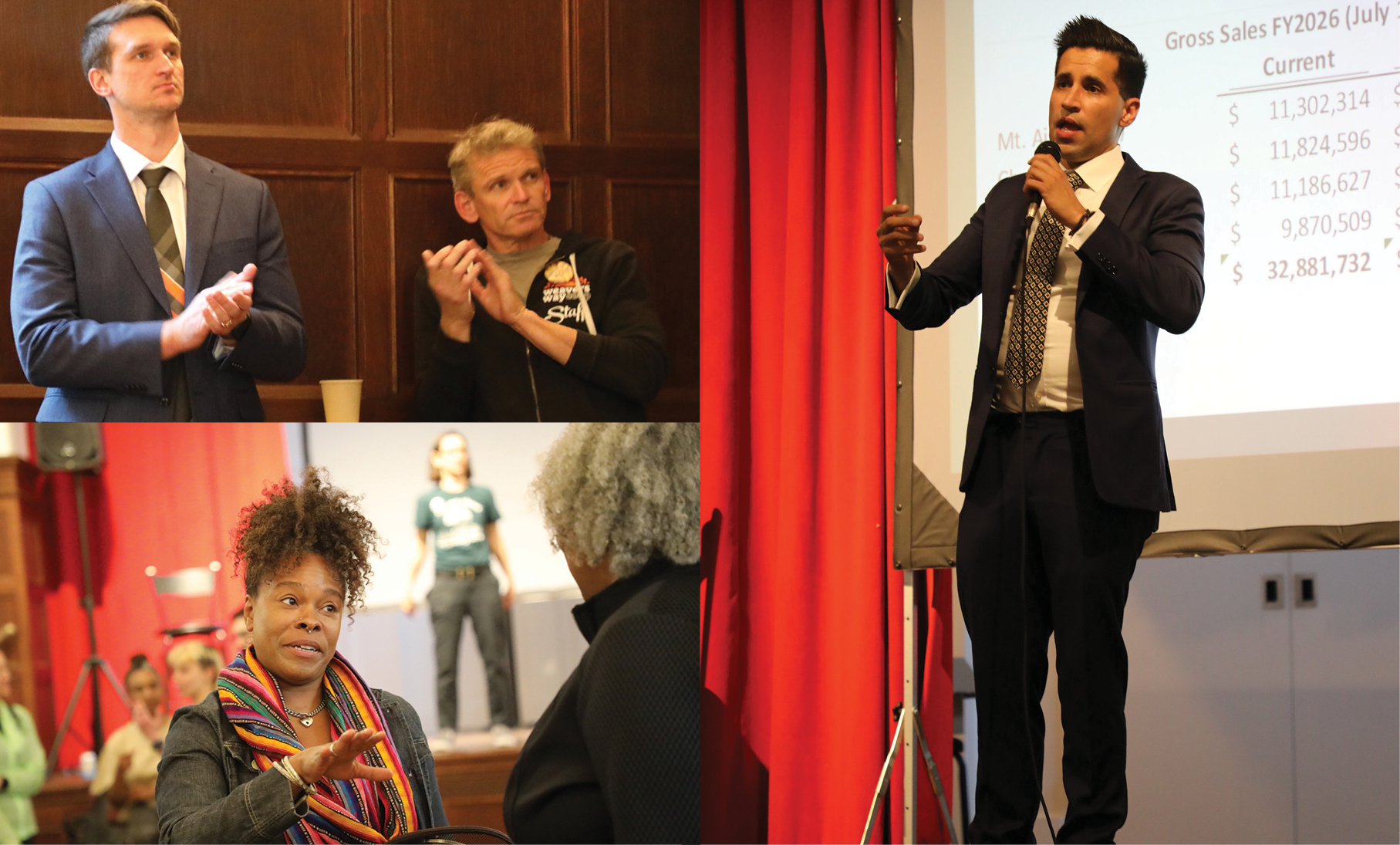
Roesser guided the crowd, estimated at 150 members, through a graphic of store sales through the third quarter of FY 2026 that showed gross sales of just under $40 million, which is well ahead of budget. Co-op discounts were 4.3% of sales — over the budgeted percentage of 4% — which was likely due to an increase in the amount of Food for All discounts.
Operating expenses through the third quarter were $13.4 million, with $9.5 million of that going to labor costs. “Through the end of the third quarter, we budgeted to basically break even, and we’re actually a little bit ahead,” Roesser said.
Roesser also went through a graphic of net income by store. Mt. Airy’s net income through the third quarter was $1.2 million, which makes it the Co-op’s most profitable business unit. That’s due in part to the amount of sales per square foot of retail space, combined with lower labor costs. Net income from the Chestnut Hill store during that same period was $747,000, with Germantown coming in third place at $616,000 and Ambler at $334,000.
“We are still growing, and we’re growing at a healthy pace, given the economic uncertainty that’s ahead of us,” he said. “…we’ve got a bit of a war chest to manage through whatever might come our way in the coming months. And this is all related to federal policy around tariffs.”
Roesser went through some slides about the upcoming renovation of the Chestnut Hill store, which will happen in three phases. The first phase — the easiest — will take place in the backyard. The size of the outdoor walk-in refrigerator/freezer will be doubled. In addition, a space will be created for the Co-op’s mobile farm market truck, which is scheduled to be delivered sometime in the fall, and the outdoor seating area will be expanded to the back of the property.
“The zoning and building permits have already been issued, so Phase One is underway,” Roesser said. “It’s the smallest part of the overall project, but it’s essential for what comes next.”
Phase Two is known as “The Building”, Roesser said, although the store is actually made up of about seven buildings that were cobbled together over decades. The building will get a new roof, new exterior facade and new windows (including for the apartments above the store). In addition, the foundation will be shored up and waterproofed.
“This is unsexy stuff,” Roesser said. “It’s stuff that needs to get done. It’s stuff that we’re doing for the people that are gonna be sitting in this room 20 years from now. This is an investment in our Co-op’s future. When you own big, old buildings, you gotta spend some coin to keep them in good form.”
Roesser describes Phase Three of the project as “the fun part”: the renovation of the store itself, scheduled for the spring and summer of 2027. All of the renovation scenarios include new equipment, a new floor, new lighting and a new HVAC system. Along with those improvements, the front end will be upgraded to include four registers, and the flow at the back end of the store will be improved by replacing the huge masonry column there with a thin, steel post.
All of the scenarios include a temporary closure of the store in the summer of 2027. When Weavers Way Mt. Airy was renovated in the summer of 2012, that store was closed for six or seven weeks.
“We had the Chestnut Hill store at the time, so a lot of the sales migrated up to Chestnut Hill,” Roesser said. “For this, we’ve got three other stores.”
There are three options for renovating the store: “Light Touch” ($1.2 million in construction costs), “Operational Efficiency” ($1.8 million) and “Go Big” ($3 million). The “Light Touch” option would involve a 10-week closure of the store and include brand new equipment, better lighting, repainting, a new floor, and a much improved front end and back end, including a new bathroom. For the most part, the layout of the store will be the same.
The “Operational Efficiency” model would expand on the Light Touch renovation by creating a new receiving area next to the store’s alley. Going with that plan would mean a 12-week closure of the store.
In the “Go Big” model, walls would be demolished and added. The front end would be further expanded to accommodate five checkouts, a third aisle would be added and the dairy case would be upgraded so that it could be restocked from behind the display. With that design, the store would be closed for 14 weeks.
“I’m not married to any of these, and I think that we have to have some discussions as an organization about what makes the most sense for us,” Roesser said. Virtual and in-person forums on the renovation took place in late May and early June.
Co-op Props from Rep. Khan
After taking questions from the audience, most of them about aspects of the Chestnut Hill store, Roesser introduced Khan, who called the Co-op “better than Trader Joe’s”, “better than Aldi” and “way TF better than Whole Foods — am I right?”
Khan added that the Co-op has a friend in himself and State Sen. Vincent Hughes, both of whom are members. “We will do whatever we can, whatever needs to be done, to make sure you guys have the support that you need — whether that’s grants, whether that’s funding, whether that’s fighting the federal government for our money, we’re gonna be there for you,” he said.
Khan added that he appreciates the Co-op for its emphasis on bringing in products from local growers and producers.
“We don’t need to be making more globalization,” he said. “We need to focus on our neighbors. We need to focus on Pennsylvania agriculture.”
Khan also talked about working with students from Norwood-Fontbonne Academy to draft a resolution for the state legislature about World Hunger Day May 28. The resolution, which included a reference to food insecurity worsening due to “recent federal changes”, passed by a vote of 193-8, including yay votes from 90 Republicans.
Khan recently introduced another bill that would double the state’s yearly investment in farms from $10 million to $19 million for agriculture innovation. So far, the bill has passed out of committee.
“It’s really an honor to represent you all,” he said. “It’s the work of me and my colleagues in the House Democratic majority to make sure that we’re investing in places like Weavers Way and make sure that we’re investing in co-ops. Make sure that we’re investing in local farms, make sure that we are investing in family farms, in family businesses and sustainability.”
As part of his efforts to legislate a living wage in Pennsylvania, Khan is working to raise the minimum wage in the state to $15 an hour from the current $7.25. “We’re hopeful that we’ll get that passed in this budget with the governor,” he said. “He’s saying that’s his top priority.”
Lastly, Khan is working on securing more funding for SEPTA and other public transit agencies in the current budget. “We cannot expect our businesses to be able to survive, we cannot expect our economy to continue to grow in the Commonwealth, if we don’t have public transit,” he said.
Khan believes it’s the job of legislators and citizens to fight for “things that are good” — including the Co-op.
“I’m committed to helping Weavers Way be great, to continue to help Weavers Way grow,” he said. “And hopefully, we’ll see continued growth in the next few years.”
And the Winners Are…
The meeting concluded with the announcement of the results of the board election, read by Board President Cheryl Croxton. She preceded her announcement by thanking all those who have served on the board, past and present. In particular, she acknowledged outgoing board director Michael Hogan, who is finishing up seven-plus years of service on the board, including a stint as treasurer.
In all, 11.9% of the membership voted in the election, up from 10.82% the previous year. The four winners were Mia Ormes (1,390 votes), Vice President Kacy Manahan (1,308 votes), Benjamin Bartley (1,274 votes) and Maci Kociszewski (1,154 votes). Croxton thanked all the candidates and everyone who voted, and encouraged members to attend a board meeting in the future.